The Paradigm Shift: From Copilots to Autonomous Agents
In the last year, the transition from conversational copilots to autonomous agents has fundamentally altered the attack surface. Agents are no longer just summarizing text; they are executing code, querying production databases, and modifying cloud infrastructure via structured tool calling (e.g., OpenAI's Function Calling, Anthropic's Tool Use).
When you give an LLM an HTTP client and a bash execution environment, prompt injection is no longer just a reputation risk—it is a vector for Remote Code Execution (RCE) and Server-Side Request Forgery (SSRF).
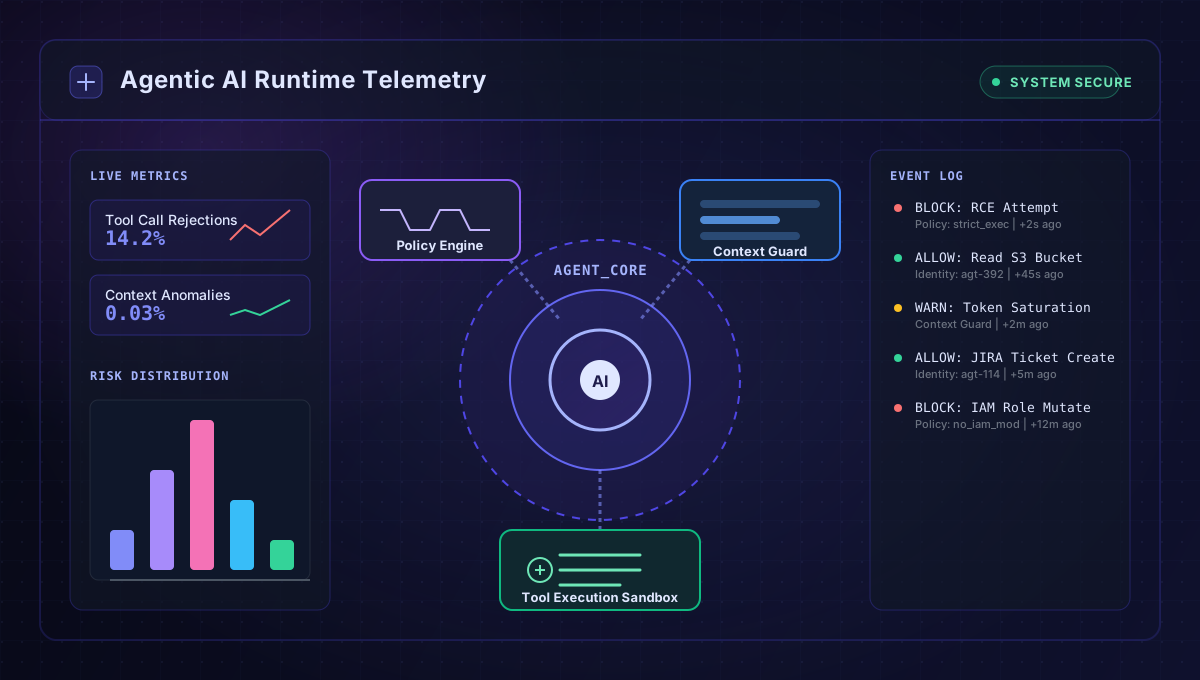
Emerging Attack Vectors in Agentic Runtimes
1. Indirect Prompt Injection via RAG (Vector Poisoning)
Adversaries don't need to interact with your agent's chat interface to compromise it. If your agent uses Retrieval-Augmented Generation (RAG) to pull context from external sources (support tickets, internal wikis, web pages), an attacker can poison that context. By embedding adversarial instructions in a seemingly benign document (e.g., hidden white-on-white text in a PDF resume), the vector database retrieves the payload, which the LLM then executes during context synthesis.2. Tool-Call Hijacking
Agents rely on JSON schema schemas to format tool calls. Advanced attacks manipulate the LLM's probability distribution to hallucinate arguments or chain tools maliciously. For example, if an agent hasread_ticket and execute_script tools, a poisoned ticket can instruct the agent to pass the ticket's contents directly into the execution environment.
3. Short-Term Memory Manipulation
Agents maintain conversational state (memory) across loops. Attackers can inject payloads designed to lie dormant in the context window until a specific trigger condition is met, subverting the agent's logic flows long after the initial malicious input was processed.Engineering the 2026 Defense Stack
To securely deploy agentic AI, organizations must implement defense-in-depth across the agent's lifecycle.
1. Sandboxing with eBPF and Seccomp
Never run agent-executed code or API calls in the host namespace. Every agent tool execution must be isolated. * Seccomp-bpf: Restrict the syscalls the agent's environment can make (e.g., blockingexecve for network-only agents).
* eBPF Network Policies: Enforce strict egress filtering at the kernel level. If an agent is only authorized to call the Jira API, eBPF rules drop packets attempting to reach any other IP, neutralizing SSRF attempts.
2. Deterministic Tool Execution Policies
Do not rely on the LLM to understand authorization. Implement an independent, deterministic policy engine (like OPA or Cedar) that sits between the LLM's output and the tool executor. * Schema Validation: Strict JSON schema enforcement using rust-based parsers before execution. * Semantic Boundary Checks: If the agent is generating a SQL query, parse the AST (Abstract Syntax Tree) to ensure it only containsSELECT statements and targets authorized tables, regardless of the LLM's intent.
3. Context Integrity and Output Scrubbing
Treat all RAG-retrieved data as untrusted input. * Input Sanitization: Use secondary, smaller models specifically trained for prompt injection detection (like ProtectAI or custom fine-tunes) to scrub retrieved context before it enters the primary agent's context window. * Data Masking: Redact PII, secrets, and sensitive markers from the agent's memory banks to prevent accidental exfiltration via tool calls.The Operational Reality
You cannot patch an LLM against injection. The mathematical nature of autoregressive models means the instruction and the data are indistinguishable in the latent space. Security in 2026 relies on accepting that the agent will be compromised, and engineering the runtime sandbox, IAM roles, and network topologies to ensure a 0% blast radius when it happens.